
AABA Newsletter June 2026, Volume 31
Updated: Jul 6
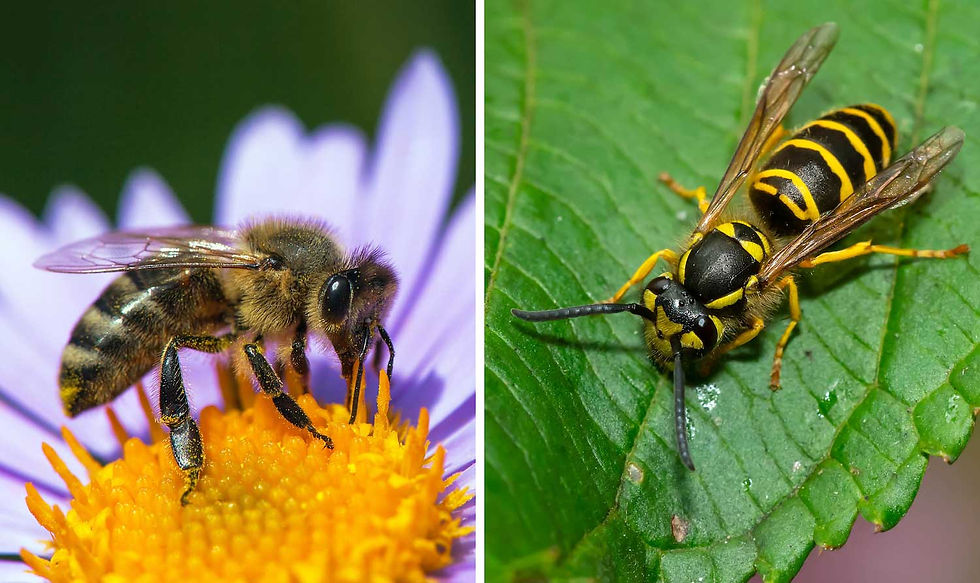
A honeybee (left) and a yellow jacket. (Photos via Shutterstock)
How to Prevent Bee and Wasp Attacks!
by Elissa Sexton, President of AABA
As temperatures rise and outdoor activities increase, encounters with bees and wasps become more common. While aggressive bee attacks are rare, it is important to know how to recognize potential hazards and respond appropriately if an incident does occur. A little preparation can go a long way toward keeping you and your family safe.
Preventing Bee and Wasp Attacks
Before mowing, weeding, trimming shrubs, or using a chainsaw, take a few minutes to inspect the area for insect activity. Bees and wasps are highly sensitive to loud noises and vibrations, which can make them defensive. Pay close attention to trees, shrubs, and other areas where insects may be nesting. If you notice bees or wasps repeatedly flying in and out of an opening in a tree, or if you spot a nest in a bush, do not disturb it. Leave the area immediately and contact a professional pest control service to safely remove the nest. It is also a good idea to keep a spray bottle filled with dish soap and water nearby while working outdoors. Soapy water can be an effective, chemical-free method for dealing with individual bees or wasps. The soap coats their bodies and interferes with their ability to breathe, often disabling them quickly.
What to Do If You Are Attacked
If you accidentally disturb a beehive or wasp nest and insects begin attacking, your first priority is to get to shelter as quickly as possible. Run indoors or into an enclosed space such as a house, vehicle, garage, or shed. Even if a few insects follow you inside, it is usually safer than remaining outside where additional insects can continue joining the attack. As you retreat, use your hands, shirt, hat, or any available clothing to cover your face, especially your eyes, nose, mouth, and ears. Bees are attracted to the carbon dioxide we exhale and often target the head and facial area, where the skin is more sensitive and vulnerable. Protecting your face while moving quickly to shelter can help reduce the risk of serious injury. When a honeybee stings, it releases an alarm pheromone that signals other bees to attack the same target. This is why multiple stings often occur in the area around a disturbed hive. The faster you move away from the hive and into an enclosed space, the sooner you remove yourself from the danger zone.
Once you are in a safe location, soapy water can be used to spray any remaining insects that may still be on your clothing or nearby. Be cautious and avoid swatting at insects, as sudden movements can increase their aggression. It is also helpful to understand the difference between bees and wasps:
Honeybees can sting only once. Their stingers have barbs that become lodged in the skin, causing the bee to die shortly after stinging.
Wasps have smooth stingers and can sting multiple times, making them particularly dangerous during an attack.
Bee and wasp attacks are uncommon, and the majority of people can work outdoors their entire lives without experiencing a serious incident. However, understanding how to identify potential nesting sites and knowing what to do in an emergency can make all the difference if an encounter occurs. The goal is not to create fear, but to promote awareness and preparedness. By inspecting your work area, avoiding active nests, keeping basic supplies on hand, and knowing how to respond quickly, you can significantly reduce your risk and enjoy outdoor activities with confidence.
 | Honey-Garlic Chicken ThighsThe ultimate 20-minute dinner! Juicy chicken thighs coated in a sweet, sticky honey garlic glaze that's perfectly caramelized. No marinating, just pure, mouth-watering flavor. |
F I N A N C I A L S J U N E | ||||
Account | Starting Balance | Debits | Credits | Ending Balance |
Checking | 2,386.27 | 100 | 0 | 2,286.27 |
Savings | 5,020.03 | 0 | 0 | 5020.03 |
Square | 0 | 0 | 143.22 | 143.22 |
Grand Total | 7,406.30 | 100 | 143.22 | 7,449.52 |
CALENDAR
Events for June
Bastrop County Beekeepers Association — Monthly Meeting June 10
Basic 101 class starts at 6 PM | Bastrop area. Beginner learning and local beekeeper networking.
Texas Natural Beekeepers Association monthly meeting and Hive Happenings — Monthly Meeting June 11, 2026
5:30 - 8:30pm | Vespa Rossa Restaurant, 3799 US 290, Dripping Springs | Free and open to the public. Topic listed by TNBA: capturing swarms, removals from structures, and relocating bees.
Hays County Beekeepers Bee Social — Monthly Meeting June 12, 2026
4 -7 pm | Bee Mindful Bee School and Farm, Driftwood | Public Q&A, networking, or hive demos. This comes from a Facebook search snippet, so I’d confirm before driving.
Wild Spirit Wild Places 3rd Annual Pollinator Celebration: Monthly Meeting: June 14, 2026
11:00am - 4:00 PM | Vista Brewing, 13551 FM 150, Driftwood | Pollinator event with TNBA booth and Youth Scholarship students. More bee adjacent than a beekeeping class.
Austin Area Beekeepers Association: Monthly Meeting: June 15, 2026
AABA Monthly Meeting May 15 · 6:00 - 8:00 PM | Lamar Senior Activity Center, Austin. Honey Extraction Workshop. All are welcome. Bring snacks to share!
Williamson County Area Beekeepers — Monthly Meeting June 23, 2026
7:00 – 9:00 PM | Georgetown Public Library, 402 W 8th St, Georgetown | Local beekeeping association meeting.
Hays County Beekeepers Bee Social — Monthly Meeting: June 26, 2026
Bee Mindful Bee School and Farm, Driftwood | Recurring Friday public Q&A, networking, or hive demos. Confirm first.


WHAT’S BLOOMING
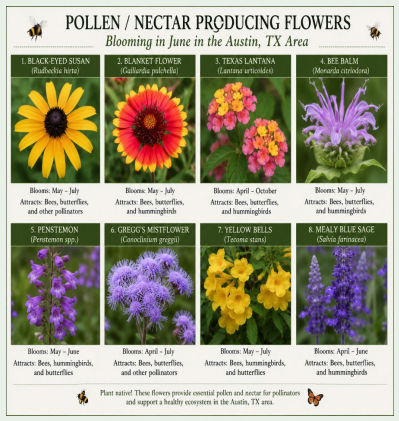
June Flora: Austin & Central TX
by Joy Mills, Secretary of AABA
Here are common pollinator-friendly plants in bloom around the Austin area this month. Bloom timing varies with rainfall, temperature, and microclimate — keep an eye on what’s actually opening near your apiary.
Watch for: Strong nectar flow is on — stay ahead of supers, monitor for swarm cells weekly, and keep an eye on water sources as temperatures climb.
SEASONAL NOTES
Top 3 Ways to Extract Honey
by Kellie Sherrill, VP of AABA
Below are the top four most common ways to extract honey that depend on your equipment and whether you want to save the wax comb. The methods range from mechanical extraction (spinning the honey out) to crushing the comb, cutting it into squares of comb, or using built-in hive systems that tap the honey straight from the box. No matter what method you use, be prepared to make a sticky mess. Always bottle your honey indoors, safely away from the bees and other opportunistic pests. I recommend always covering your workspace with a plastic table cloth before you begin and possibly laying a plastic painter’s tarp on the ground if you think there will be lots of dripping. Keep a clean damp towel nearby and make sure if you are using a honey bucket it is closed and locked before you begin. Have your clean dry jars nearby with the lids removed. Gather your equipment and enjoy the sweet rewards of beekeeping. Happy harvesting!
1. Crush and Strain This is the most popular, cost-effective method for beginners or those with only one or two hives, as it requires no expensive machinery.
The Process: The entire comb is scraped or cut out of the frame and physically crushed—often using a potato masher, fork, or wooden spoon. You can also purchase an uncapping tool and serrated knife for cutting the tops off the capped honey for a small amount. If you are using foundation you can also use a silicone spatula to scrape the honey off the frame. The resulting mixture of honey and beeswax is poured into a metal mesh strainer or cheesecloth, and the pure honey strains through into a honey bucket overnight.
The Benefit: Low initial startup cost and you get a nice yield of beeswax as a byproduct.
The Drawback: It destroys the comb. The bees need to rebuild the wax from scratch for the next harvest, reducing your potential honey yield for that season.
Equipment needed: Food-grade buckets, mesh strainer bags or cheesecloth, and a blunt tool for crushing, an uncapping tool or serrated.
2. Cut Comb Honey This is the easiest and most rustic way to enjoy or sell honey, as it requires no processing at all.
The Process: The entire honeycomb (still full of honey) is cut into small sections or squares directly from the frame.
The Benefit: No mess, no extraction machinery required, and customers can eat the delicious raw honey directly alongside the edible beeswax.
The Drawback: This will not work if you have solid foundations on your frames.
Equipment needed: A clean cutting tool, and specialized plastic clamshell containers to display or sell the squares.
3. Centrifugal Extraction This is the most widely used method for larger operations or for beekeepers who want to reuse the honeycomb. It saves a lot of time especially when you have multiple hives but the equipment is expensive. If you are only going to use it once or twice a year you might consider joining your local beekeepers association and borrowing their extraction equipment. Members of the Austin Area Beekeepers Association are allowed to borrow the extraction equipment for free as a member benefit.
The Process: The thin wax caps sealing the honeycomb are shaved off using a heated or serrated knife. The frames are then loaded into a "honey extractor," which is essentially a drum that spins the frames. Centrifugal force pulls the honey out of the cells without destroying the wax comb.
The Benefit: Because the comb remains intact, the bees can be given the empty comb back to refill, saving them a massive amount of energy (they don't have to build as much new wax).
Equipment needed: Uncapping knife, uncapping scratcher (for missed spots), and a manual or electric honey extractor/centrifuge.


Comments